Electronic fence needed between gangsterism and politics
tribune242 editorial
ANYONE who has followed the rise and fall of Jamaica's drug kingpin, Christopher "Dudus" Coke, or read KC Samuels' account of Coke's meteoric rise and eventual fall into the arms of a waiting "Uncle Sam", should be grateful that the Bahamas' own drug kingpin, "Ninety" Knowles, was eventually extradited to the US before he had time to consolidate his own growing empire.
By the time Dudus, who was born into a life of crime, had run his course, he was becoming more powerful even than the Jamaican government. However, before his saga is done, what might be revealed during his trial in the US, could well bring down the JLP government of Bruce Golding.
Dudus' father, Jim Brown, who died mysteriously in a fire in his prison cell in Jamaica, was Prime Minister Edward Seaga's man. Brown was a don who could be relied on to deliver the votes from Tivoli Gardens for Seaga's Jamaica Labour Party (JLP). Brown headed the Shower Posse and violence and bloodshed entered Jamaican politics. The politicians and hoodlums were too close for comfort right up to last year when "the President" - Dudus himself - challenged the prime minister, who under pressure had agreed his extradition to the US.
The don of Tivoli, who by this time had taken his father's criminal enterprise and built it into an international empire, was receiving all the Jamaican government's construction contracts, as well as collecting from his international drug-dealing enterprises. Over time he had built himself such a strong outpost that by the time the US government targeted him, he had an armed force ready to challenge his arrest. The residents of Tivoli barricaded themselves in to protect their don and opened fire on the forces sent to arrest him. By the time the armed forces had quelled the uprising, 74 Jamaicans, including a police officer, were dead, but Dudus was still on the run.
For more than a month Dudus eluded the authorities. When he was eventually caught, disguised in a woman's wig, he waived his rights and agreed to be extradited to the US to face drugs and weapons charges.
Tivoli Gardens was former prime minister Edward Seaga's stronghold. Seaga took care of the residents. Dudus, taking on his father's mantle as head of the Posse, pushed the prime minister's care and protection of Tivoli residents to a new level.
Dudus had two faces. To the people of Tivoli and all those who paid him homage he was a good man, a generous man, a man without blemish. However, to others he was a gangster, a crook, a drug and gun peddler - a threat to society. The Americans described him as a dangerous narcotics kingpin.
Golding's government fought the extradition request. Golding explained that the attorney general and justice minister had refrained from signing Dudus' extradition because the evidence as outlined by the US was obtained illegally. Eventually an embarrassed Golding, with calls for his resignation echoing in his ears, apologised and signed.
Here in the Bahamas, employing every delaying tactic in the courts, "Ninety" Knowles from his jail cell in Fox Hill prison, held the Americans at bay for six years. President George Bush had personally labeled him an international narcotics kingpin under the Foreign Narcotics Kingpins Designation Act. He was described as the head of a multinational drug organization and in the US was found guilty of drug conspiracy and sentenced to 28 years in a Florida prison. The jury recommended that his US$19.5 million in assets be forfeited to the US government.
However, Knowles' extradition created a furor in Nassau, and even drew out placard-carrying demonstrators when then foreign affairs minister Fred Mitchell signed a warrant of surrender before Knowles had exhausted his legal appeals. The Court of Appeal recorded its "serious concern" at the manner that Knowles had been removed from the Bahamas.
However, legally right or wrong, it was the best decision for the Bahamas. Already Knowles, like Dudus, was building his little empire of supporters. He was generous with his ill-gotten gains, which he distributed liberally among the poor.
According to Wikileaks, a US diplomat wrote in November 2006 that Knowles' extradition would lead to the "withdrawal of an important source of election funding." Yes, Knowles was a menace to society.
But as Samuels concluded in his book "Jamaica's first President - Dudus, 1992-2010" -- "What needs to be realised here even more than anything else, is the deadly end result of politics and corruption. Duduses are a dime a dozen, hundreds have been born since he was extradited. He was not the first and he won't be the last to face such a fate, and therein again is the problem -- because if Jamaica is to move forward as a nation, and his type of behaviour is to be confined to the pages of history, then the line between gangsterism and politics must become an electronic fence."
Bahamian politicians take note.
Friday, June 10, 2011
tribune242 editorial
A political blog about Bahamian politics in The Bahamas, Bahamian Politicans - and the entire Bahamas political lot. Bahamian Blogger Dennis Dames keeps you updated on the political news and views throughout the islands of The Bahamas without fear or favor. Bahamian Politicians and the Bahamian Political Arena: Updates one Post at a time on Bahamas Politics and Bahamas Politicans; and their local, regional and international policies and perspectives.
Sunday, June 12, 2011
Saturday, June 11, 2011
Who is Wang Lequan?
Loose Ends in Western China
I've noticed in the past few days that people are getting tired of Tibet as an endless news story (kind of like the Iraq War). Even so, I feel compelled to continue posting interesting tidbits gleaned from here and there, if at a more sensible pace.
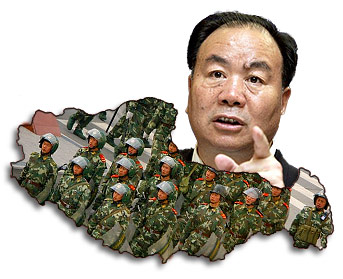
There've been two stories published in the past 24 hours that analyze the party machinations behind the crackdowns in Lhasa and other Tibetan areas. A propaganda-style piece in The Sunday Times is of particular interest to this blog as Xinjiang boss Wang Lequan is fingered as the shot-caller for this whole mess:
The real mastermind of Chinese policy towards the restive ethnic minorities is a 67-year-old lifetime communist functionary named Wang Lequan.
Wang has proclaimed himself to be the top terrorist target in China. Nominally, he heads the party in Xinjiang, which, like Tibet, is a vast, remote and resource-rich region troubled by separatism.
However, Wang sits on the powerful politburo in Beijing and has assumed overall direction of policy in both places. He devised the model that has stifled Muslim culture in Xinjiang, staged political trials and executions, poured in millions of Chinese settlers and extracted mineral and energy resources to feed the economy....
His henchman, now applying the master's methods in Tibet, is Zhang Qingli, the region's sharp-tongued party secretary. Zhang is the man who called the Dalai Lama "a wolf in monk's clothes, a devil with a human face". He rose up the hierarchy in Xinjiang and was transferred to Tibet in 2005 as a reward for his loyalty.
What's up with phrases like faceless trio, mastermind, and henchman in a supposedly unbiased report from a respected British paper? Sounds more like the kind of language you'd expect from Xinhua.
Zhang is also mentioned prominently in a New York Times article examining the initially weak response of security forces confronted with rampaging protesters in Lhasa. The story subtly accuses him of 'pulling a Hu Jintao' as events unfolded:
Ultimately, the man responsible for public order in Lhasa is Mr. Zhang, Tibet’s party chief. Mr. Zhang is a protégé of President Hu Jintao, whose own political career took flight after he crushed the last major rebellion in Tibet in 1989.
According to one biographer, Mr. Hu actually made himself unavailable during the 1989 riots when the paramilitary police needed guidance on whether to crack down. The police did so and Mr. Hu got credit for keeping order, but he also assured himself deniability if the crackdown had failed, the biographer wrote.
Mr. Zhang also has an excuse; he was at the National People’s Congress in Beijing.
And Reuters has been running a story saying that Chinese officials are accusing the Dalai Lama "of colluding with Muslim Uighur separatists in China's western Xinjiang region." I haven't been able to find the original source of this accusation... anyone else?
Although things are calm at the moment, tensions in Xinjiang are high with the surrounding provinces in flames. Just today I've heard rumors that (a) there was a bus bombing in Urumqi last night, (b) Han Chinese students were killed by Uyghurs in Kuqa, and (c) a Han Chinese policeman was killed in Kuqa by Uyghurs. Probably nothing to these whispers, but anxiety creates this kind of wild-fire rumor mongering.
March 24, 2008

Branville McCartney - the Democratic National Alliance (DNA) leader is risking his political career
Third party support
thenassauguardian editorial
Since the resignation of Bamboo Town MP Branville McCartney from the Free National Movement (FNM), the national airwaves have been dominated by talk of a third political party to challenge the FNM and Progressive Liberal Party (PLP).
The last major politician to try the third party route was former PLP deputy leader Dr. Bernard Nottage in 2002 when his Coalition for Democratic Reform (CDR) took on the two major parties. Dr. Nottage’s party failed and he lost his seat. CDR candidates were crushed as non-contenders at the polls.
At the time Bahamians were upset with the FNM, which was fractured and falling apart. They chose to go with a Perry Christie. He was a part of a major political force and he was also a new face to leadership. Christie ran as a “new PLP”, seeking to break with the somewhat tarnished legacy of the defeated old PLP.
At that 2002 election there was something new that was still a part of the mainstream for Bahamians to choose. Dr. Nottage could not compete with that.
Almost ten years later, a young, attractive and charismatic politician (McCartney) is trying the same thing with his Democratic National Alliance (DNA). He is not as politically accomplished as Dr. Nottage was at the time he led the CDR to defeat. However, McCartney may have an advantage.
At this general election, neither political party has anything new to offer at the leadership level. FNM leader Hubert Ingraham and PLP leader Perry Christie both entered the House of Assembly in 1977. Both men are known. Neither man can claim to be new. Neither man can suggest he can offer something he has not already offered during his long political career.
At this election it could be argued that a message could be presented, stating that Ingraham and Christie, and the FNM and the PLP, are the same thing and a new direction is needed for the country. In recent years there have been annual murder records; the down economy has persisted; and the Bahamian education system is doing poorly.
Though this environment exists, it is unclear if Bahamians will break with the PLP/FNM duopoly.
The key for any third party movement would be to determine if dissatisfaction with the parties could be harnessed into votes. If that dissatisfaction cannot be, starting a third party will only waste money.
Ultimately, Bahamians will have to decide if they will accept others at the national table of decision making or if they think only card carrying PLPs or FNMs should lead The Bahamas.
Third parties should understand what is at stake. If defeated badly at the general election, that third force will look like a joke never to be considered again.
McCartney is risking his political career.
Jun 11, 2011
thenassauguardian editorial
thenassauguardian editorial
Since the resignation of Bamboo Town MP Branville McCartney from the Free National Movement (FNM), the national airwaves have been dominated by talk of a third political party to challenge the FNM and Progressive Liberal Party (PLP).
The last major politician to try the third party route was former PLP deputy leader Dr. Bernard Nottage in 2002 when his Coalition for Democratic Reform (CDR) took on the two major parties. Dr. Nottage’s party failed and he lost his seat. CDR candidates were crushed as non-contenders at the polls.
At the time Bahamians were upset with the FNM, which was fractured and falling apart. They chose to go with a Perry Christie. He was a part of a major political force and he was also a new face to leadership. Christie ran as a “new PLP”, seeking to break with the somewhat tarnished legacy of the defeated old PLP.
At that 2002 election there was something new that was still a part of the mainstream for Bahamians to choose. Dr. Nottage could not compete with that.
Almost ten years later, a young, attractive and charismatic politician (McCartney) is trying the same thing with his Democratic National Alliance (DNA). He is not as politically accomplished as Dr. Nottage was at the time he led the CDR to defeat. However, McCartney may have an advantage.
At this general election, neither political party has anything new to offer at the leadership level. FNM leader Hubert Ingraham and PLP leader Perry Christie both entered the House of Assembly in 1977. Both men are known. Neither man can claim to be new. Neither man can suggest he can offer something he has not already offered during his long political career.
At this election it could be argued that a message could be presented, stating that Ingraham and Christie, and the FNM and the PLP, are the same thing and a new direction is needed for the country. In recent years there have been annual murder records; the down economy has persisted; and the Bahamian education system is doing poorly.
Though this environment exists, it is unclear if Bahamians will break with the PLP/FNM duopoly.
The key for any third party movement would be to determine if dissatisfaction with the parties could be harnessed into votes. If that dissatisfaction cannot be, starting a third party will only waste money.
Ultimately, Bahamians will have to decide if they will accept others at the national table of decision making or if they think only card carrying PLPs or FNMs should lead The Bahamas.
Third parties should understand what is at stake. If defeated badly at the general election, that third force will look like a joke never to be considered again.
McCartney is risking his political career.
Jun 11, 2011
thenassauguardian editorial
Philip 'Brave' Davis told Free National Movement supporters that Progressive Liberal Party Chief Perry Christie is not his leader and is "dicey" during a trip to Cat Island, claimed Prime Minister Hubert Ingraham
PM claims Philip Davis said Christie is not his leader
By TANEKA THOMPSON
Tribune Staff Reporter
tribune242
tthompson@tribunemedia.net
PHILIP 'Brave' Davis told Free National Movement supporters that Progressive Liberal Party Chief Perry Christie is not his leader and is "dicey" during a trip to Cat Island, Prime Minister Hubert Ingraham claimed.
Elizabeth MP Ryan Pinder, who accompanied Mr Davis on the trip, reportedly told the same supporters that his allegiance lies with the Cat Island and Rum Cay MP and not Mr Christie.
Mr Ingraham made these revelations as he gave his summary on the 2011/2012 budget yesterday.
"The member for Cat Island who is the deputy leader of his party and who expects to replace (Mr Christie) in a short period of time, I'm told that you told some of my men in Cat Island over the weekend that Christie is not your leader and ... that Christie is dicey.
"The member for Elizabeth, somebody asked him 'I thought you supported Christie'. He turned around and said 'Brave is my man'," Mr Ingraham continued, eliciting cheers and laughs from members on his side.
During his contribution, Mr Ingraham also criticised Mr Davis for heaping blame on government for the crime problem gripping the country.
The nation's chief said Mr Davis expects government to have found a "magic" solution to crime in its four years in office and has called for more resources to be allocated to police and the justice system.
"But never have those resources been more generous and more in evidence than on our watch," said the North Abaco MP.
Mr Ingraham told Parliament that violent crime is a symptom of seeds sown 30 to 40 years ago and is closely related to the underground activities and the drug trade.
The Government plans to release the names and background of murder victims to show that many being killed are not caught in random incidents but are linked to criminal activity, said Mr Ingraham.
Friday, June 10, 2011
tribune242
By TANEKA THOMPSON
Tribune Staff Reporter
tribune242
tthompson@tribunemedia.net
PHILIP 'Brave' Davis told Free National Movement supporters that Progressive Liberal Party Chief Perry Christie is not his leader and is "dicey" during a trip to Cat Island, Prime Minister Hubert Ingraham claimed.
Elizabeth MP Ryan Pinder, who accompanied Mr Davis on the trip, reportedly told the same supporters that his allegiance lies with the Cat Island and Rum Cay MP and not Mr Christie.
Mr Ingraham made these revelations as he gave his summary on the 2011/2012 budget yesterday.
"The member for Cat Island who is the deputy leader of his party and who expects to replace (Mr Christie) in a short period of time, I'm told that you told some of my men in Cat Island over the weekend that Christie is not your leader and ... that Christie is dicey.
"The member for Elizabeth, somebody asked him 'I thought you supported Christie'. He turned around and said 'Brave is my man'," Mr Ingraham continued, eliciting cheers and laughs from members on his side.
During his contribution, Mr Ingraham also criticised Mr Davis for heaping blame on government for the crime problem gripping the country.
The nation's chief said Mr Davis expects government to have found a "magic" solution to crime in its four years in office and has called for more resources to be allocated to police and the justice system.
"But never have those resources been more generous and more in evidence than on our watch," said the North Abaco MP.
Mr Ingraham told Parliament that violent crime is a symptom of seeds sown 30 to 40 years ago and is closely related to the underground activities and the drug trade.
The Government plans to release the names and background of murder victims to show that many being killed are not caught in random incidents but are linked to criminal activity, said Mr Ingraham.
Friday, June 10, 2011
tribune242
Friday, June 10, 2011
WikiLeaks - U.S. Embassy official in a 2004 diplomatic cable: Franklyn Wilson argued that the U.S. should support Perry Christie’s hope to become a regional leader since the Bahamian prime minister was America’s “Tony Blair” inside CARICOM

Cable: Wilson defended Christie to Americans
BY CANDIA DAMES
NG News Editor
thenassauguardian
candia@nasguard.com
Diplomatic cables reveal detailed discussions American diplomats had with prominent Bahamian businessman Franklyn Wilson who repeatedly defended the Pindling administration’s actions during the 1980s drug era, and also defended the Christie administration’s “record of inaction.”
“Mr. Wilson emotionally presented the case for Perry Christie, calling him the United States’ best friend inside CARICOM councils,” wrote a U.S. Embassy official in a 2004 cable.
The diplomat wrote that Wilson argued during a September 30, 2004 luncheon that the U.S. should support Christie’s hope to become a regional leader since the Bahamian prime minister was America’s “Tony Blair” inside CARICOM.
“Wilson again raised the prime minister’s belief that he was ignored and left exposed by the United States during events surrounding the resignation of Haitian ex-President Aristide and that he should have been consulted by senior [U.S. government] officials,” the diplomat wrote.
“Wilson claimed, however, that Christie bore no grudges at being left out of the loop by the United States and Canada.”
According to the cable, Wilson remained loyal to Christie, telling diplomats that Christie’s personality and manner made it possible for him to become friends with everyone, including President George W. Bush, thereby allowing him to exert a moderating and calming influence within CARICOM to counter the proclivities of that body’s more extreme members.
Wilson compared Christie to the late former prime minister Sir Lynden Pindling, saying Sir Lynden had quietly and effectively served as a moderating influence during the 1970s and thus served U.S. strategic interests, the cable said.
“What was true some 30 years ago, argued Wilson, was equally true today,” the embassy official said.
“The United States, continued Wilson, needed to ignore tactical deviations and remember that strategically Perry Christie was America’s best friend and supporter in the region.”
According to the cable, Wilson declared several times that the United States should support and enhance Christie’s stature within CARICOM in its own self-interest.
Wilson reportedly expressed the view that Christie believed that he had been in the forefront of the CARICOM effort to persuade the ex-Haitian president to peacefully resign his office.
“Given his leadership role in the effort, argued Wilson, the United States owed it to Christie to have received a call from senior [U.S. government] officials, or the White House, advising him ‘when the United States decided to change direction on Aristide’ and ‘remove him from power’.”
According to the cable, a U.S. Embassy official reminded Wilson that Christie had been briefed on the rapid spiral of breaking events leading up to Aristide demitting office and that CARICOM “was not an organization well-suited to handling crises.”
Noting that Prime Minister Christie was scheduled to speak at the approaching Miami Herald’s annual Americas Conference, the U.S. ambassador expressed the hope that Christie would take a positive position that reflected the deep, long-standing and overall positive relationship between the United States and the region, the cable said.
It noted that the theme of Christie’s remarks at the conference was ‘Friend or Foe? Can the Caribbean and the U.S. Repair Their Damaged Relations?’
The cable said Christie “feigned surprise” and dismay at the topic assigned to him when he had an opportunity to speak to a U.S. Embassy official before the trip.
The official expressed to Christie, according to the cable, the ambassador’s hope that he “would use his spotlight to focus on the overwhelmingly positive bilateral and mutually beneficial multilateral regional relationship and not engage in an unproductive negative analysis.”
SIR LYNDEN’S LEGACY
Referring again to Wilson, the embassy official noted that he has been closely identified with the PLP throughout his life and holds Sir Lynden “in a status close to sainthood.”
The official wrote that Wilson was a member of Christie’s “kitchen cabinet” and one of the PLP’s principal financiers and fundraisers.
“He is accustomed to serving as a transmission belt both to send, and to receive, messages intended for the prime minister,” the cable said.
The official wrote: “Wilson is very proud of his rise to meteoric wealth and, during the course of the meeting, repeatedly referred to his humble past, when, as the youngest of 11 children in a working class family, he had to sleep on the floor until his older sisters grew up and moved out of the house and a bed opened up for him.
“He is fanatically devoted to Pindling, who identified him, became his godfather, and opened the doors that allowed Wilson to be successful.”
In a 2003 cable, an embassy official described Wilson as a “bombastic speaker who frequently cuts others off in conversation.”
The official wrote that Wilson “spent much of the hour and half meeting offering a passionate defense of the record of Sir Lynden Pindling.”
“He insisted that allegations of narcotics corruption against Pindling were completely unfounded and claimed that the Commission of Inquiry bore him out on this point,” the cable said.
“He brushed aside questions about how Sir Lynden had amassed his obvious wealth during his years in office and the influence of notorious Colombian narcotics kingpin Carlos Lehder, and said that the stories about Pindling were the result of jealousy and ingratitude, a plot orchestrated by former U.S. Ambassador Carol Boyd Hallett and former Prime Minister Hubert Ingraham who ‘wouldn’t have been anything without Pindling’.”
Wilson told the Americans, according to the cable, “no one has cooperated more” with the U.S. on drug interdiction than Pindling and said the seizure statistics bear him out on this assertion.
The diplomat wrote: “He expressed great scorn toward Hubert Ingraham for betraying Pindling then setting out to destroy his reputation after Ingraham became prime minister, which Wilson claimed destroyed Pindling’s health and led to his death.
“Wilson said that only when Pindling neared his death did Ingraham ‘repent’ and seek reconciliation with Pindling on the latter’s death bed.
“Wilson claimed that the impressive sendoff given to Pindling by Ingraham’s government when he died in 2000 was proof that Ingraham felt remorseful about what he had done to Pindling’s reputation.”
According to the cable, Wilson believed that the seeds of the PLP’s 2002 election victory were laid at Pindling’s funeral, as the state ceremony and effusive eulogies allowed the PLP to escape from its image of corruption.
In the cable, Wilson and Bishop Neil Ellis were described as “the two individuals outside of the Bahamian government considered to have the most influence on Prime Minister Perry Christie’s government.”
Jun 09, 2011
thenassauguardian
Thursday, June 9, 2011
The less tolerant and accommodating we are of criminal enterprise and behaviour, the more effective will be our fight against crime...
The corrupters of the judicial system
tribune242 editorial
IN 1981 then Attorney General Paul Adderley considered a court system not in tune with the society in which it functioned, lawyers with neither a good nor high reputation, and corrupters of the system as part of this country's problems in getting criminals off the streets.
On the floor of the same House from which Mr Adderley had made that observation 30 years before, Prime Minister Ingraham advised politicians to distance themselves from criminals.
"The stark reality is that we did not reach the current level of crime overnight.
"And our attitude towards crime makes a difference. Complaining about crime, yet aiding and abetting criminal behaviour hurts our shared fight against crime," Mr Ingraham said.
"The less tolerant and accommodating we are of criminal enterprise and behaviour, the more effective will be our fight against crime.
"The entire society has an obligation to assist the police in doing their jobs."
Mr Adderley was of the opinion that the police were not getting the assistance they needed from the courts. He believed the judicial system was demonstrating more sympathy for the law-breaker than for the long suffering public.
Mr Adderley criticised the category of people who perpetrate acts of corruption -- influence peddlers and people seeking permission by paying off someone.
Lawyers, he said, among other professions, fall into this category.
"For the most part," said Mr Adderley, "the vast majority of lawyers are entitled to a good and high reputation, but those who are entitled to a good and high reputation do not have either a good or a high reputation because there are some lawyers who have an atrociously bad reputation who are entitled to neither a good nor a high reputation.
"By the conduct of a relatively small number of lawyers in the Bahamas, lawyers generally today have a low reputation.
"This is to be attributed to those lawyers who belong in the category of the corrupt."
He also had something to say about the category of lawyers who charge clients "outrageously, almost criminally high fees."
He then moved to those -- especially drug dealers -- who bribed the courts.
"One of the most corrupting influences on the total system is the amount of money which is in the hands of the drug traffickers," he said.
As attorney general he found it necessary to have drug cases put in a distinct category.
Two years before he felt he had justifiable reasons to give directives to magistrate's court prosecutors that any case involving drugs could not be withdrawn without the consent of the Office of the Attorney General.
He knew of "prevalent incidents" that justified his decision "because some way along the way the system had been corrupted."
Even juries in the Bahamas were bought, he said, but unfortunately, sufficient evidence could not be found to prosecute.
We leave it to our readers to judge whether much has changed in the profession since Mr Adderley's 1981 observations.
What he as Attorney General complained of in 1981 remains among the many problems that make the fight against crime difficult today.
June 08, 2011
tribune242 editorial
tribune242 editorial
IN 1981 then Attorney General Paul Adderley considered a court system not in tune with the society in which it functioned, lawyers with neither a good nor high reputation, and corrupters of the system as part of this country's problems in getting criminals off the streets.
On the floor of the same House from which Mr Adderley had made that observation 30 years before, Prime Minister Ingraham advised politicians to distance themselves from criminals.
"The stark reality is that we did not reach the current level of crime overnight.
"And our attitude towards crime makes a difference. Complaining about crime, yet aiding and abetting criminal behaviour hurts our shared fight against crime," Mr Ingraham said.
"The less tolerant and accommodating we are of criminal enterprise and behaviour, the more effective will be our fight against crime.
"The entire society has an obligation to assist the police in doing their jobs."
Mr Adderley was of the opinion that the police were not getting the assistance they needed from the courts. He believed the judicial system was demonstrating more sympathy for the law-breaker than for the long suffering public.
Mr Adderley criticised the category of people who perpetrate acts of corruption -- influence peddlers and people seeking permission by paying off someone.
Lawyers, he said, among other professions, fall into this category.
"For the most part," said Mr Adderley, "the vast majority of lawyers are entitled to a good and high reputation, but those who are entitled to a good and high reputation do not have either a good or a high reputation because there are some lawyers who have an atrociously bad reputation who are entitled to neither a good nor a high reputation.
"By the conduct of a relatively small number of lawyers in the Bahamas, lawyers generally today have a low reputation.
"This is to be attributed to those lawyers who belong in the category of the corrupt."
He also had something to say about the category of lawyers who charge clients "outrageously, almost criminally high fees."
He then moved to those -- especially drug dealers -- who bribed the courts.
"One of the most corrupting influences on the total system is the amount of money which is in the hands of the drug traffickers," he said.
As attorney general he found it necessary to have drug cases put in a distinct category.
Two years before he felt he had justifiable reasons to give directives to magistrate's court prosecutors that any case involving drugs could not be withdrawn without the consent of the Office of the Attorney General.
He knew of "prevalent incidents" that justified his decision "because some way along the way the system had been corrupted."
Even juries in the Bahamas were bought, he said, but unfortunately, sufficient evidence could not be found to prosecute.
We leave it to our readers to judge whether much has changed in the profession since Mr Adderley's 1981 observations.
What he as Attorney General complained of in 1981 remains among the many problems that make the fight against crime difficult today.
June 08, 2011
tribune242 editorial
Wednesday, June 8, 2011
Will the United States Embassy cables being published by The Nassau Guardian via WikiLeaks have an impact on how Bahamians vote in the upcoming general election?

WikiLeaks: An election issue?
thenassauguardian editorial
Within a year, Bahamians will again be voting for a government. The third non-consecutive term of the Free National Movement (FNM) in office is coming to an end. The general election campaign hasn’t officially started yet, but both the FNM and the Progressive Liberal Party (PLP) have hosted sporadic rallies.
The economy, the crime problem and leadership are likely major issues to be discussed along the way. Reading some of the Bahamian blogs and websites, some seem to also wonder if the United States Embassy cables being published by The Nassau Guardian via WikiLeaks will have an impact on how Bahamians vote.
They should, as Bahamians should evaluate as much information as possible before making a decision on the party they will vote for. The times are serious. Irrational voting based on old family ties or tradition will not help advance the country from where it is to where we all want it to be.
The cables present a behind the scenes view of diplomacy in this country and also the opinions of our closest and most powerful friend, the United States. More specifically, they provide insight into how our leaders are perceived by the U.S. The analysis is raw and candid, as it was not meant for public consumption.
The Americans have interacted closely with our political leaders and ruling class for years. It is their job to get to know Bahamian power brokers as demonstrated by their interviews and conversations with FNM leader Hubert Ingraham and PLP leader Perry Christie. It is also their job to get to know the want to be power brokers, such as Cassius Stuart who had too much to say to an American official during the Elizabeth by-election.
The Americans have also worked closely with both parties and both prime ministers – Christie and Ingraham – during their terms in office. At times, as will be revealed in upcoming cables, the embassy officials and our leaders worked very closely together on issues of local and international significance.
Thus far, based on the cables published, Ingraham has come across as over-confident, competent and a little arrogant. Christie has come across as less than organized, a nice guy and indecisive. The Americans have perceived character traits in the men that Bahamians have too.
What the cables can offer to voters is the impression of a critic, the U.S., who has a major interest in The Bahamas. For that critic The Bahamas is important, as it is one of three countries bordering the U.S. Its friendship and partnership are very important to America, as Bahamian intransigence would lead to a massive spike in the amount of drugs and illegal migrants flowing into that country.
The cables present serious analysis from a serious partner. They are not gossip. They are meant to help the U.S. State Department set policy towards this country.
With The Bahamas still not clearly out of recession, a recession that began at the end of 2008, and a fourth homicide record in five years a near certainty, the cables will likely not be the main issue at the general election. However, they will make for some good reading over the next few months.
At the end of this process we suggest that our readers take another read of the volumes of material written by the Americans on the issues analyzed between 2003 and 2010.
Then, if there is a particular issue that piques your curiosity, we suggest questions should be asked to canvassing politicians during the campaign.
Jun 07, 2011
thenassauguardian editorial
Subscribe to:
Posts (Atom)