Wednesday, June 15, 2011

WikiLeaks classified diplomatic cable: Prime Minister Hubert Ingraham placed Freeport’s economy in “jeopardy” and possibly stalled several major projects planned for Grand Bahama by not renewing the work permit of former Grand Bahama Port Authority (GBPA) Chairman Hannes Babak at the end of 2009


WikiLeaks Bahamas


Cable: PM put GB economy in jeopardy


By JUAN McCARTNEY
NG Senior Reporter
thenassauguardian
juan@nasguard.com


Prime Minister Hubert Ingraham’s decision not to renew the work permit of former Grand Bahama Port Authority (GBPA) Chairman Hannes Babak at the end of 2009 placed Freeport’s economy in “jeopardy” and possibly stalled several major projects planned for Grand Bahama, claimed a classified diplomatic cable obtained by The Nassau Guardian through WikiLeaks.

Babak’s work permit was not renewed after it expired on December 31, 2009.

Ingraham publicly announced the decision about Babak’s work permit earlier that December.

According to the cable, which was classified on December 18, 2009, Babak asked the U.S. Embassy to help change the prime minister’s mind about the work permit.

The embassy official Babak reportedly spoke to remained “noncommittal”, according to the cable.

The GBPA was the subject of a bitter, protracted ownership dispute between Sir Jack Hayward and the family of the late Edward St. George.

In December 2009, Babak was in negotiations to sell Sir Jack’s significant stake in the GBPA to Mid-Atlantic Projects (a U.S. company).

The cable stated that the embassy felt that Babak's ultimate departure, “…could result in further delays in Grand Bahama's development just as the expected sale to Mid-Atlantic had sought to jump-start progress.”

The Mid-Atlantic deal fell apart in April 2010.

The embassy official claimed that the refusal to allow Babak to continue to legally work in the country was, “likely made out of anger at Babak's move not to obtain Ingraham's blessing before moving forward with the Mid-Atlantic deal as well as a not-so-discreet desire to increase Chinese involvement in Grand Bahama's development plans through Hutchison-Whampoa (a Chinese company with major business interests in Freeport).”

During the time Babak was seeking renewal of his work permit, he was in the midst of brokering several deals with major U.S. companies intended to help alleviate Grand Bahama’s economic woes.

The embassy official said Babak’s removal, “(put) into jeopardy ongoing negotiations with major U.S. firms to bring liquid natural gas (LNG) re-gasification facilities and other badly needed commercial ventures to the country's second largest city, which suffers from nearly 15 percent unemployment.”

There were also several other deals reportedly in the works with U.S. entities — including energy and medical care companies — that Babak was overseeing at the time.

One deal under negotiation involved the establishment of an offshore, ship-based Liquid Natural Gas (LNG) re-gasification plant and on-shore LNG storage facilities operated by Texas-based Excelerate Energy and Virginia-based AES, the cable noted.

“The arrangement would enable electricity delivery services via underwater cable to Florida Light and Power as well as Bahamas Electricity Corporation (BEC),” justified the cable, which also cited possible savings for BEC if the deal was to go through.

The status of that deal is unclear.

The cable further stated that Babak was negotiating with a U.S. hospital construction company to build a facility in Grand Bahama that could have been worth up to $100 million.

Reported renewal conditions

The cable said Babak was called to a meeting with then Minister of State for Immigration Branville McCartney at the Office of the Prime Minister sometime in June 2009, shortly after Babak’s work permit was submitted for renewal.

The cable further claimed that McCartney explained that the government was only prepared to renew Babak’s work permit past that December if he met four conditions: settle the ongoing GBPA ownership dispute; treat Bahamians fairly; compete fairly with Bahamian companies and not stand in the way of the construction of a cruise port terminal in Williams Town.

In a January 2010 interview with The Nassau Guardian, the prime minister acknowledged that McCartney was sent to meet with Babak and tell him the conditions under which his work permit would be renewed.

Ingraham did not disclose those conditions. He said he was surprised that some people were surprised by his announcement about Babak’s work permit.

Babak told an embassy official that Ingraham was in favor of Chinese company Hutchison-Whampoa purchasing all of Sir Jack and the St. Georges’ shares but told him “any legitimate buyer was fine,” according to the cable.

The GBPA remains unsold to this day, though there is talk that a foreign entity is interested in purchasing it.

The cable said Babak interpreted one of the conditions the government placed on renewing his work permit at the end of 2009 as “a demand to promote [the relative of a high-ranking government official] to [a senior post in] the Port Authority,”

The embassy official claimed Babak refused to promote the person, who he claimed was “not qualified for the position.”

As far as the third reported condition, the cable claimed Babak said the government had an “inaccurate” perception that he was involved in a conflict of interest as far as the granting of contracts from GBPA to a company to which he had previous financial ties was concerned.

The embassy claimed Babak said McCartney appeared “uninterested” in seeing any proof to the contrary.

Austrian-born Babak told The Freeport News in December 2009 that he owned no businesses in Grand Bahama and was in the process of trying to sell his shares in the Freeport Concrete Company.

As far as the Williams Town port is concerned, the cable said that Babak had “publically advocated for the terminal to be located (there) because no reef existed there.”

Even though the U.S. Embassy refused to get involved, the official characterized Babak as a “long-time supporter of U.S. commercial interests in The Bahamas (who) would continue to do so if he stayed in his current role.”

In his interview with the Freeport News not long after Ingraham’s announcement, Babak said it was his hope that the prime minister reverses his decision, but would continue to do what he thinks is best for Grand Bahama no matter what happened.

"I like to live in Freeport,” Babak said a year-and-a-half ago. “I am a Grand Bahamian resident. I have a house here that was the house of my dad and after he passed away it became my house. It would be my wish to live and work here."

Numerous attempts to reach Babak were unsuccessful. The prime minister did not return a request for comment up to press time.

Jun 14, 2011

thenassauguardian

It was in 2002 that [then MP for the Kennedy constituency] Dr. Bernard Nottage's Coalition for Democratic Reform (CDR) tried to do what Bamboo Town MP Branville McCartney and his Democratic National Alliance (DNA) is now trying

DNA must remember the CDR

thenassauguardian editorial


It was in 2002 that a sitting Member of Parliament last tried to do what Bamboo Town MP Branville McCartney is now trying to do. Dr. Bernard Nottage broke away from Progressive Liberal Party (PLP) before the 2002 general election and formed the Coalition for Democratic Reform (CDR). Dr. Nottage was the then MP for the Kennedy constituency.

We all know what happened to the CDR, which ran in most of the constituencies in 2002: It lost badly.

Out of the 130,536 votes cast across the country in 2002, the CDR won 2,755 votes (2.1 percent). On the Family Islands the CDR did worse. Out of 42,783 votes cast outside of New Providence, the CDR won 404 votes (0.9 percent).

In 1997 when the PLP was nearly wiped out of the Parliament, Dr. Nottage, under the PLP banner, was one of the few members of his party to win a seat. He defeated Free National Movement (FNM) candidate Ashley Cargill by 156 votes. When he severed ties with the PLP and ran outside of its banner five years later, Dr. Nottage was beaten badly by a PLP political newcomer, Kenyatta Gibson. Gibson won 1950 votes and Dr. Nottage 499 votes.

Others who ran as CDRs lost badly in 2002 and won in 2007 once they joined a major party. In Carmichael, Charles Maynard made no impact as a CDR candidate. He won 196 votes and PLP John Carey, the winner, secured 1818 votes. In South Beach, Phenton Neymour won 117 votes for the CDR and PLP candidate Agatha Marcelle, the winner, secured 1838 votes.

Both Neymour and Maynard won seats in the House of Assembly five years later as FNMs. Neymour won South Beach over the PLP by 299 votes, receiving the support of 1919 constituents. Maynard won Golden Isles by 62 votes, attracting the support of 1824 voters.

Dr. Nottage too found the same result when he went back home to the PLP. He won the Bain and Grants Town seat by 774 votes.

Branville McCartney should examine the 2002 and 2007 general elections. He is attempting to do the same thing Dr. Nottage attempted to do. Dr. Nottage and the CDR failed. Bahamians did not go for the new thing then.

We acknowledge that the times are different. Neither the PLP nor FNM is offering a new leader as the PLP did in 2002. However, Bahamians are conservative voters. As a result of the FNM split in 1977 — resulting in the FNM and the Bahamas Democratic Party (BDP) — a group other than the PLP or FNM won a meaningful share of the vote. The BDP was the official opposition in 1977.

Bahamians, based on the results of our recent elections, are not interested in change outside of the major parties. But, as we have said before, this should not stop McCartney from trying. What it should do, however, is moderate his expectations and those of his supporters.

As history has shown via the course of so many politicians, what McCartney is likely doing, consciously or not, is auditioning for a prominent role in one of the major parties. Hubert Ingraham, Perry Christie, Fred Mitchell, Paul Adderley, Sir Orville Turnquest, Dr. Nottage and others have had time in the political wilderness before joining or rejoining either the PLP or FNM and sitting around the Cabinet table. Ingraham and Christie each became prime minister.

So, if the DNA is destined for failure the key for McCartney will be to win his seat. He would then have the option of being absorbed into the PLP or FNM during the next Parliament.

Though his roots are with the FNM, if the DNA is crushed and McCartney gives up on the party he should not rule out joining the PLP. Ingraham, a former PLP chairman, did what he had to do. He joined the FNM and became PM.

Politics is the art of pragmatism. If the PLP loses, Christie will be asked to go. And he might actually go — though no one in the party is powerful enough to make him go. If he leaves, a ‘civil war’ would result in the PLP. Lots of want to be leaders would emerge and few would have the capacity to lead or win a general election. A charismatic McCartney could do well on that side.

Jun 14, 2011

thenassauguardian editorial

Tuesday, June 14, 2011

The Democratic National Alliance (DNA) party has grave concerns over the most recent visit by the Deputy Secretary of the Political and Legal Affairs Commission of the Communist Party of China’s (CPC) Central Committee, Wang Lequan on the Prime Minister, Deputy Prime Minister, Minister of National Security and the Chairman of the Free National Movement party

Chinese Visit:

From the DNA party on Facebook


The Democratic National Alliance’s (DNA) have grave concerns, among other things, over the most recent visit by officials of the Communist Party of China on the Prime Minister and Deputy Prime Minister, the Minister of National Security and the Chairman of the Free National Movement Party.

In light of recent discussions in the House of Assembly last week by the Prime Minister’s over his intentions to bring about amendments to the Parliamentary Elections Act, and the Leader of the Opposition reference to the role that campaign financing plays in the integrity of elections (particularly elections in the Bahamas), the DNA is requesting the FNM Party to advise the Bahamian people about any possible financial arrangements or dealings that it has or might have with the Communist Party or any other Chinese connection in its party’s upcoming re-election campaign.

The DNA understands that one of the first and most immediate response from the Free National Movement, by way of the Prime Minister, its Chairman, or Minister of State for Finance - if they see fit or feel a need to be accountable to the Bahamian people at all - will be to deny, deny, deny that China is making any sort of contribution to its party or campaign. They may even go as far as to claim that what is being suggested by the DNA is only a figment of the Party’s imagination and could be, potentially, perceived as a slap in the face to a “goodwill” nation like China, who, they would want us to believe, is primarily looking to help our struggling nation and economy.

We expect the Free National Movement to duck and dodge around this issue – again, if it sees fit or even feel a need to be accountable to the people – but as a matter of trust, the DNA and the Bahamian people hope that the FNM will alley public concerns over this matter by making public, now and during this election campaign season, all contributions and favors coming from foreign/non-Bahamian entities; our present social condition – as it relates to backdoor deals with foreign interests, particularly during election season - has already taught us that, sometimes, if it looks too good to be true, then it probably is, and, most times, nothing in life is free – national track stadium included.

With:

• a national track and field stadium built with Chinese money and labour

• new roads and infrastructural upgrades financed and soon to be manned primarily with Chinese labour

• the Baha Mar project financed by millions of Chinese dollars and soon to be manned by thousands of Chinese workers

• the Freeport Container Port, the Freeport Harbour Company, and the Grand Bahama Airport all under, or partly under, the control of the Chinese Hutchison Whampoa Limited

• large scale agricultural farming soon to be operated and supervised by the Chinese in Andros on acres of sacred Bahamian land

• large scale lobster, crawfish, and other marine fish harvesting to feed the hungry appetites of billions of middle and upper class Chinese living in mainland China and other Chinese territories (NOTE: Chinese Official, “we [China] are still suffering from over-fishing and fish catches have been declining each year. In addition, not only does China has a huge population but many Asian countries have huge populations and they have [a] great demand for marine products” (in connection with this issue the government must insist on a joint venture with Bahamians. In addition all stakeholders in the Bahamas ought to be consulted such as persons in Spanish Wells and other fishermen. The stakeholders must be involved and this venture must be mutually beneficial to both parties. It must not be detrimental to local markets and to the tourist industry and at the end of the day, we in the Bahamas must be in the position to export not only in this region but around the world making this a profitable industry.)

• and God knows what else it has planned for the Bahamas - a nation that can hardly feed itself

The Communist Party of China has more than a vested interest in making sure that the Free National Movement is returned and remains in power.

The ability of a people and nation like ours to have free access to information related to foreign investments in local and national elections are critical to the integrity of the election process, and with no accountability, transparency, or oversight presently in place, foreign governments can secretly throw millions of its disposable and readily available dollars behind the Free National Movement and into its re-election bid, much to the detriment to the Bahamas and future generation of Bahamians.

The DNA wants the Bahamian people and the world to hold this government accountable in its dealings with China as it seeks to secure another term in office. It is important to the best our ability, as a people and as a nation, to remain in control of our own destinies. Without any transparency and accountability by the Free National Movement, particularly as the sitting government, Bahamians risk having these special interest show up one day, only to be drilling in our National parks the next day – killing, among other things, many of our baby turtles and fish, while at the same time, destroying our natural environment.

Additionally, in my contribution to the Budget debate in the House last Wednesday, I pointed out several characteristic flaws of this present government that their “supposed” Budget revealed:

• They, after three terms in office under a leader with 25 years experience in political office, still have no broad-based programs to grow the economy at a sufficiently high rate to affect any significant change in our economy;

• They still have no concrete, long term financial development plan that will help reduce this 4.2 billion dollar debt that hangs over our, our children, and their children’s head; and on their own

• They have no sustainable vision for moving this country forward into any century, 21st or otherwise.

The comment by the Chairman of the FNM to Communist Party officials made these points, among other things, blatantly clear.

“There is much that we in The Bahamas can learn from the wisdom and experience of the Chinese people and government. I am particularly impressed with the success of your planning through your five-year plans and I do believe a greater attention to national planning would certainly be a great benefit to The Bahamas — not just every year a budget, but to have a vision over a longer term.”

Coming from the Chief Executive Officer of the Free National Movement, Mr. Bethel, the statement “I do believe a greater attention to national planning would certainly be a benefit to the Bahamas” is an unambiguous, clearly worded indication that FNM has NO plan or vision for the Bahamas (none longer than a year, as he notes), and that the people’s fears and their desire to get rid of the Free National Movement as the government of the Bahamas is justified.

We too like Mr. Bethel believe that a sitting government should “not just every year [have] a budget, but . . . a vision over a longer term.” But again, after three terms in office, and no plan, the DNA questions whether anything will change with the Free National Movement or if it will be more of the same – hat tricks, smoke and mirror acts, bells and whistles, and other sorts of illusions pulled from its bag of tricks intended to deceive a more knowledgeable generation of people. As such, the DNA and the Bahamian are incensed with the Free National Movement and its Chairman for this shameful admission and we remind the Party of its leaders 1997 statements and say, “You deceive the people you violate your oath of office; you betray the trust placed in you by the people, it will be the bench for you! No exceptions! And It’s non-negotiable!”

On top of that, The DNA questions the suggestiveness in Chairman Bethel words when he says that “the Bahamas can learn from the wisdom and experience of the Chinese people and government,” particularly with China being a communist nation that has a track record of denying to its own people many of the very liberties and freedoms that so many of us try to enjoy in this present, but slowly fading, democratic and liberal Bahamas.

We would like the Chairman to explain how the Chinese vision and model will work in a Christian and democratic Bahamas made up of approximately 350,000 people. The Democratic National Alliance and the Bahamian public await the Chairman’s answer, and we are sure that his answer will be as interesting as his original statement.

For the sake of truth and transparency, the DNA and the Bahamian people would like Chairman Bethel to, also, make public the Chinese five year vision plan - sooner rather than later - so that we can hopefully see what it is that “impressed” the Party’s CEO. In the same vein, we hope that we do not see the Chinese vision plan appear, in one form or another, disguised as the FNM’s new five year vision plan for the Bahamas, particularly since the Chairman has already made us aware that his party does not have one. The DNA and the Bahamian people will hold the governing party accountable from now until Election Day.

14th June 2011

DNA on Facebook

The WikiLeaks cables should be viewed as a learning experience by public officials... and the release of the diplomatic documents have allowed Bahamians to see more clearly the actions of their leaders... says Former Prime Minister Perry Christie

Christie: WikiLeaks a learning experience


CANDIA DAMES
NG News Editor
thenassauguardian
candia@nasguard.com


Former Prime Minister Perry Christie says public officials should view the WikiLeaks cables as a learning experience and added that the release of the diplomatic documents have allowed Bahamians to see more clearly the actions of their leaders.

“This kind of exposure that we’re getting now is more to give Bahamians an understanding that these things happened and perhaps at the end of the process those of use who are in public life clearly will be more disciplined in any discussions we have (with U.S. Embassy officials) moving forward, “ said Christie in a recent interview with The Nassau Guardian.

He added, “I think as a result of what we have seen, the entire world will learn from the experience of the leaks.

“That is very obvious because one can not take anything for granted.

“When someone sits with you as prime minister, a communication is made to Washington based on what an ambassador says was his experience with a prime minister, who is me, and there is no third party to certify the truth of that.

“And so you ask me, did I say it and I said it is not the kind of thing I would say to an ambassador.”

Christie in that respect was referring specifically to a comment attributed to him in the cables, that he did not appoint former Minister of Trade and Industry Leslie Miller to his cabinet because of his qualifications, but to keep an eye on him.

He denied making the comment and suggested that something he said may have been taken out of context.

“Leslie Miller and I enjoy an incredibly strong relationship today,” Christie added.

In the cables, U.S. Embassy officials are overwhelmingly critical of Christie and his style of leadership.

After he called elections in 2007, an Embassy official wrote, “The timing of the elections is typical of Christie’s style of governance — uncertain, waiting until the last possible moment, with action forced by outside events rather than strategic planning.”

Comparing current Prime Minister Hubert Ingraham and Christie, the official wrote: “Ingraham is known from his time as prime minister as a decisive leader who accomplished much while suppressing dissension. His critics claim he rode roughshod over opponents.

“Christie has a well-deserved reputation as a waffling, indecisive leader, who procrastinates and often fails to act altogether while awaiting an elusive consensus in his Cabinet.”

Christie told The Guardian he is disappointed as a public official that the Embassy officials “seem to have taken on the FNM propaganda on me, I mean even to minute details”.

“They seem to mirror what has been said,” he said.

In another cable that was written in 2003 after Ingraham had a meeting with a U.S. Embassy official, the then former prime minister was quoted as saying Christie has always been weak and indecisive and lacks vision, but is a good man.

Ingraham, according to the cable, also described the Christie Cabinet as a “collection of incompetents.”

Christie told The Guardian that he was not surprised that Ingraham expressed such strong views about him.

“I have strong views about him,” the opposition leader added. “I don’t know whether I would have said it to anyone.”

Christie brushed aside repeated suggestions in the cables that he did not have a firm grip on his cabinet.

“Anyone who sat around that table would know that I was in charge of my cabinet, and that whether it’s foreign affairs or any other subject, that I would have been very assiduous in understanding all of the issues,” he said.

“The one thing though that I think was very clear to me is that I had the opportunity to meet with the president of the United States of America (George W. Bush) on a number of occasions, one very formal visit with two other leaders in the region.

“And I used that opportunity to impress upon him all of the principles of the relationship between the United States and the Commonwealth of The Bahamas, so that there was no misunderstanding.”

Christie said he also made it clear to then U.S. Secretary of State Condoleezza Rice when she visited The Bahamas that it is important for The Bahamas to have a relationship with Cuba.

“I made it very clear that when it came to the Commonwealth of The Bahamas and its relationship with Cuba and other countries in the region we were in the region and it was a matter of necessity that we understood what was taking place in the region, including Cuba, and that it ought to be for the benefit of the Americans that they would have a friend like the Bahamas sitting in places like Cuba and Haiti and being able to represent the fact that we enjoy relationships that are very strong historically and will continue to be so,” he said.

Christie said he does not think the cables will hurt him politically.

“At the end of the day you try as a public figure to get people to know you, to know who you are, what you’re like and your integrity,” he said.

“And so, when Prime Minister Ingraham, for example, who spent near 20 years of his life in a direct partnership with me, trusting his future and his family’s future with me, I know he knows me.

“I know he knows my integrity. I know he knows the degree of my responsibility and so when he mischaracterizes me, it is all politics. He is very adept at it and oftentimes I chide myself for not being able to match him in kind in being able to do it, but you know I can’t be Hubert Ingraham.”

Christie also responded to comments attributed to Mount Tabor Baptist Church Bishop Neil Ellis.
Referring to Ellis’ alleged comment to an embassy official that he (Christie) was not a “true man of God”, Christie responded with a chuckle, “Well, he might be right.”

“The bishop has an assignment and the bishop understands people,” he added.

“He knows my heart. We’ve been close enough for him to know that. He knows the respect I have for him and I would expect him to be honest in his deliberations.

“If he doesn’t have a clear understanding of my commitment to the Lord and Christianity and how I manifest it…I think he’s very safe in what he said about me — not being a true man of God.

“And I assume a true man of God are people like him.”

Another cable suggested that Christie did not have a grip on foreign affairs matters while he was prime minister and deferred to Fred Mitchell, who served as foreign affairs minister in his administration.

In that 2006 cable, Christie responded to then U.S. Ambassador John Rood’s concerns over The Bahamas’ voting record in the United Nations and limited multilateral cooperation with the U.S. at the U.N.

“In response to the ambassador’s concerns, Christie distanced himself from Mitchell’s handling of Bahamian policy, saying ‘foreign policy is driven by Fred and Ministry of Foreign Affairs without involvement of my office’,” the cable said.

Asked to respond to this, Christie explained to The Guardian that as a prime minister he did not micromanage.

“That is what a prime minister like me would have tried to do with ambassadors to stop them from coming directly to the Office of Prime Minister unless it was a matter of great import and to channel whatever they do through the foreign minister,” he said.

“Fred Mitchell was an incredibly adept foreign minister and was recognized in this region as that. Whatever one wants to say, he was very, very good at performing the obligations of his office and therefore I had great confidence in Fred Mitchell being able to receive information from the Americans, interpret that information and pass it on to me and to colleagues.

“And to that extent I was trying to create a culture that foreign affairs was sufficiently important that you didn’t have to have a prime minister trying to wield the power [over] the office of the foreign minister.”

Christie said Mitchell communicated with the Office of the Prime Minister practically every day, and still communicates with him often as shadow minister of foreign affairs.

Jun 14, 2011

thenassauguardian

Monday, June 13, 2011

Philip ‘Brave’ Davis - Progressive Liberal Party (PLP) deputy leader: “I am committed to ensuring that Perry Gladstone Christie is the next prime minister of the Commonwealth of The Bahamas and that the PLP is returned to power,”...

Davis affirms commitment to Christie


BRENT DEAN
NG Deputy News Editor
thenassauguardian
brentldean@nasguard.com


Progressive Liberal Party (PLP) deputy leader Philip ‘Brave’ Davis yesterday publicly affirmed his commitment to assisting Leader of the Opposition Perry Christie in his bid to become prime minister again after Prime Minister Hubert Ingraham told Parliament on Thursday that Davis recently told Free National Movement (FNM) supporters Christie is not his leader.

“I am committed to ensuring that Perry Gladstone Christie is the next prime minister of the Commonwealth of The Bahamas and that the PLP is returned to power,” said Davis in a statement.

“No political mischief, false accusations, fabricated stories or propaganda will change the widely held public view that Hubert Ingraham must go and must go now.

“Our country deserves better than Hubert Ingraham and the FNM and their lame attempts to distract from their failures in every major area of governance.”

Ingraham also said PLP Elizabeth Member of Parliament Ryan Pinder, who was also on the recent trip to Cat Island where Davis’ alleged remarks were made, said that he is allied to Davis.

“Mr. Ingraham is politically desperate. He can see the writing on the wall. It is sad that of all the serious matters facing our country and the important matters discussed and debated in Parliament over the past few days that such utterances could find a place of prominence in the news cycle,” said Davis, who is also the Cat Island, Rum Cay and San Salvador MP and the PLP’s national campaign coordinator.

Referring to a United States Embassy cable from 2003 published by The Nassau Guardian via WikiLeaks, Davis said Ingraham and the FNM have their own divisions.

“What is factual and supported by evidence though is that Deputy Prime Minister Brent Symonette does not have the support of his leader, Hubert Ingraham,” said Davis.

Ingraham told the Americans, according to the cable, that the best thing that could happen would be for Symonette to challenge for the FNM leadership, because he “would be beaten so soundly that it would shatter all his illusions.”

But at the FNM convention more than two years later, Symonette did not challenge for the leadership. He went for deputy leader and won. He was made deputy prime minister when the party won at the polls in 2007.

It is known within the PLP that Davis would someday like to be the leader of the party. However, based on Christie’s overwhelming victory at the PLP’s October 2009 convention, it appears that Christie will hold on to the post of PLP leader until he decides to give it up. More than 80 percent of voting PLPs supported Christie at that convention.

Jun 11, 2011

thenassauguardian

Sunday, June 12, 2011

Gangsterism and politics: Bahamian politicians take note of the deadly end result of politics and corruption

Electronic fence needed between gangsterism and politics

tribune242 editorial


ANYONE who has followed the rise and fall of Jamaica's drug kingpin, Christopher "Dudus" Coke, or read KC Samuels' account of Coke's meteoric rise and eventual fall into the arms of a waiting "Uncle Sam", should be grateful that the Bahamas' own drug kingpin, "Ninety" Knowles, was eventually extradited to the US before he had time to consolidate his own growing empire.

By the time Dudus, who was born into a life of crime, had run his course, he was becoming more powerful even than the Jamaican government. However, before his saga is done, what might be revealed during his trial in the US, could well bring down the JLP government of Bruce Golding.

Dudus' father, Jim Brown, who died mysteriously in a fire in his prison cell in Jamaica, was Prime Minister Edward Seaga's man. Brown was a don who could be relied on to deliver the votes from Tivoli Gardens for Seaga's Jamaica Labour Party (JLP). Brown headed the Shower Posse and violence and bloodshed entered Jamaican politics. The politicians and hoodlums were too close for comfort right up to last year when "the President" - Dudus himself - challenged the prime minister, who under pressure had agreed his extradition to the US.

The don of Tivoli, who by this time had taken his father's criminal enterprise and built it into an international empire, was receiving all the Jamaican government's construction contracts, as well as collecting from his international drug-dealing enterprises. Over time he had built himself such a strong outpost that by the time the US government targeted him, he had an armed force ready to challenge his arrest. The residents of Tivoli barricaded themselves in to protect their don and opened fire on the forces sent to arrest him. By the time the armed forces had quelled the uprising, 74 Jamaicans, including a police officer, were dead, but Dudus was still on the run.

For more than a month Dudus eluded the authorities. When he was eventually caught, disguised in a woman's wig, he waived his rights and agreed to be extradited to the US to face drugs and weapons charges.

Tivoli Gardens was former prime minister Edward Seaga's stronghold. Seaga took care of the residents. Dudus, taking on his father's mantle as head of the Posse, pushed the prime minister's care and protection of Tivoli residents to a new level.

Dudus had two faces. To the people of Tivoli and all those who paid him homage he was a good man, a generous man, a man without blemish. However, to others he was a gangster, a crook, a drug and gun peddler - a threat to society. The Americans described him as a dangerous narcotics kingpin.

Golding's government fought the extradition request. Golding explained that the attorney general and justice minister had refrained from signing Dudus' extradition because the evidence as outlined by the US was obtained illegally. Eventually an embarrassed Golding, with calls for his resignation echoing in his ears, apologised and signed.

Here in the Bahamas, employing every delaying tactic in the courts, "Ninety" Knowles from his jail cell in Fox Hill prison, held the Americans at bay for six years. President George Bush had personally labeled him an international narcotics kingpin under the Foreign Narcotics Kingpins Designation Act. He was described as the head of a multinational drug organization and in the US was found guilty of drug conspiracy and sentenced to 28 years in a Florida prison. The jury recommended that his US$19.5 million in assets be forfeited to the US government.

However, Knowles' extradition created a furor in Nassau, and even drew out placard-carrying demonstrators when then foreign affairs minister Fred Mitchell signed a warrant of surrender before Knowles had exhausted his legal appeals. The Court of Appeal recorded its "serious concern" at the manner that Knowles had been removed from the Bahamas.

However, legally right or wrong, it was the best decision for the Bahamas. Already Knowles, like Dudus, was building his little empire of supporters. He was generous with his ill-gotten gains, which he distributed liberally among the poor.

According to Wikileaks, a US diplomat wrote in November 2006 that Knowles' extradition would lead to the "withdrawal of an important source of election funding." Yes, Knowles was a menace to society.

But as Samuels concluded in his book "Jamaica's first President - Dudus, 1992-2010" -- "What needs to be realised here even more than anything else, is the deadly end result of politics and corruption. Duduses are a dime a dozen, hundreds have been born since he was extradited. He was not the first and he won't be the last to face such a fate, and therein again is the problem -- because if Jamaica is to move forward as a nation, and his type of behaviour is to be confined to the pages of history, then the line between gangsterism and politics must become an electronic fence."

Bahamian politicians take note.

Friday, June 10, 2011

tribune242 editorial

Saturday, June 11, 2011

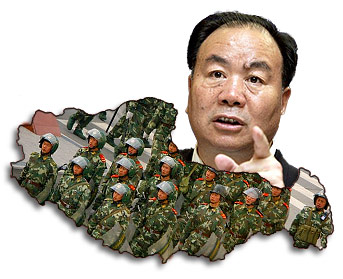
Who is Wang Lequan?

Bahamas - China relations in the spotlight with the high-level visit of the Deputy Secretary of Political and Legal Affairs Commission of the Communist Party of China’s (CPC) Central Committee, Wang Lequan


Loose Ends in Western China


china.notspecial


I've noticed in the past few days that people are getting tired of Tibet as an endless news story (kind of like the Iraq War). Even so, I feel compelled to continue posting interesting tidbits gleaned from here and there, if at a more sensible pace.


There've been two stories published in the past 24 hours that analyze the party machinations behind the crackdowns in Lhasa and other Tibetan areas. A propaganda-style piece in The Sunday Times is of particular interest to this blog as Xinjiang boss Wang Lequan is fingered as the shot-caller for this whole mess:

The real mastermind of Chinese policy towards the restive ethnic minorities is a 67-year-old lifetime communist functionary named Wang Lequan.

Wang has proclaimed himself to be the top terrorist target in China. Nominally, he heads the party in Xinjiang, which, like Tibet, is a vast, remote and resource-rich region troubled by separatism.

However, Wang sits on the powerful politburo in Beijing and has assumed overall direction of policy in both places. He devised the model that has stifled Muslim culture in Xinjiang, staged political trials and executions, poured in millions of Chinese settlers and extracted mineral and energy resources to feed the economy....

His henchman, now applying the master's methods in Tibet, is Zhang Qingli, the region's sharp-tongued party secretary. Zhang is the man who called the Dalai Lama "a wolf in monk's clothes, a devil with a human face". He rose up the hierarchy in Xinjiang and was transferred to Tibet in 2005 as a reward for his loyalty.


What's up with phrases like faceless trio, mastermind, and henchman in a supposedly unbiased report from a respected British paper? Sounds more like the kind of language you'd expect from Xinhua.


Zhang is also mentioned prominently in a New York Times article examining the initially weak response of security forces confronted with rampaging protesters in Lhasa. The story subtly accuses him of 'pulling a Hu Jintao' as events unfolded:

Ultimately, the man responsible for public order in Lhasa is Mr. Zhang, Tibet’s party chief. Mr. Zhang is a protégé of President Hu Jintao, whose own political career took flight after he crushed the last major rebellion in Tibet in 1989.

According to one biographer, Mr. Hu actually made himself unavailable during the 1989 riots when the paramilitary police needed guidance on whether to crack down. The police did so and Mr. Hu got credit for keeping order, but he also assured himself deniability if the crackdown had failed, the biographer wrote.

Mr. Zhang also has an excuse; he was at the National People’s Congress in Beijing.


And Reuters has been running a story saying that Chinese officials are accusing the Dalai Lama "of colluding with Muslim Uighur separatists in China's western Xinjiang region." I haven't been able to find the original source of this accusation... anyone else?


Although things are calm at the moment, tensions in Xinjiang are high with the surrounding provinces in flames. Just today I've heard rumors that (a) there was a bus bombing in Urumqi last night, (b) Han Chinese students were killed by Uyghurs in Kuqa, and (c) a Han Chinese policeman was killed in Kuqa by Uyghurs. Probably nothing to these whispers, but anxiety creates this kind of wild-fire rumor mongering.


March 24, 2008


china.notspecial

Bahamas - China relations in the spotlight with the high-level visit of the Deputy Secretary of Political and Legal Affairs Commission of the Communist Party of China’s (CPC) Central Committee, Wang Lequan